Land Development — 6 min read
Infill subdivision on the Peninsula: small sites, large constraints
Three lots in Belmont can outperform three hundred acres elsewhere. The reason is scarcity, and the cost is process.
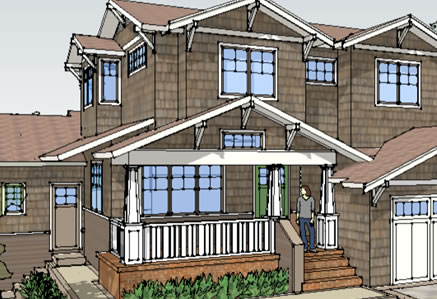
The San Francisco Peninsula has almost no remaining greenfield. What it has is leftover geometry: oversized lots behind existing homes, deep parcels fronting two streets, aging single-story commercial buildings on land that is now residential in every practical sense. These sites yield two, three, or six homes rather than two hundred, and that scale is precisely why they remain available.
Why small sites are attractive
Institutional builders need scale to justify overhead and cannot deploy a regional team on a three-lot map. Individual owners rarely have the capital or the appetite for a multi-year approval process. That leaves a durable middle where a small, local, well-capitalized operator competes against few others, in submarkets with the deepest end-user demand in the country.
The constraint list is long
- —Topography and grading limits, common in the hillside communities from Belmont to Portola Valley.
- —Heritage tree ordinances that can dictate building footprint and driveway alignment.
- —Access, fire truck turning radii, and secondary egress requirements.
- —Utility capacity and the cost of extending sewer or undergrounding overhead lines.
- —Neighbor-driven design review focused on privacy, view, mass, and construction impacts.
How the work is actually done
Successful infill subdivision looks less like development and more like diligence followed by patience. Survey and title first. A civil engineer who has worked in that specific jurisdiction. A design that anticipates the neighbor objection instead of arguing with it. Early, direct conversation with adjacent owners before the staff report is written. Then a schedule built with the assumption of one continuance.
The exit
Two exits exist and both should be underwritten. Sell finished lots to a builder once the final map records, taking the entitlement margin and shedding construction risk. Or build through, capturing the construction margin as well, with the capital and duration that requires. Choosing at the outset, and knowing which one the market will actually reward, is what separates a land investment from a land position.
Pacific States Capital has carried this work through completion in Belmont, Menlo Park, Redwood City, and South San Francisco: acquisition, entitlement, and where the return justified it, construction.
Pacific States Capital Corp. is an acquisition, investment and land development firm in Menlo Park, California. Get in touch to discuss a project.